
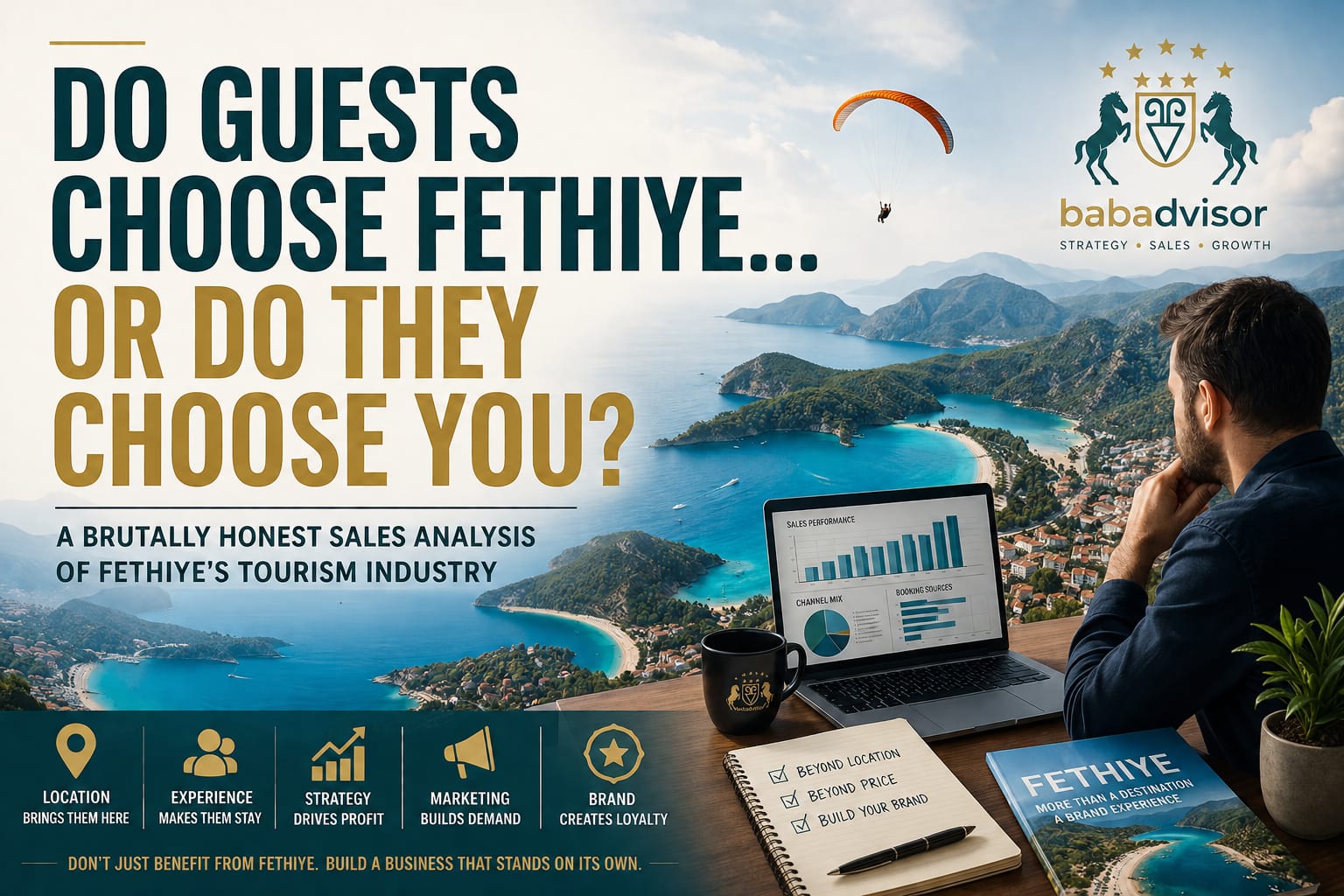
Do Guests Choose Fethiye… or Do They Choose You?
A Brutally Honest Sales Analysis of Fethiye’s Tourism Industry
We are right in the thick of the summer season. Phones are ringing off the hook, reservation forms are flooding in, and tables and sunbeds are packed to capacity. As a Fethiye hotel operator, restaurant owner, boat captain, or agency leader, you probably look in the mirror while closing the register at night and proudly tell yourself: “We must be doing a phenomenal job—look at this crowd, there’s literally no room to breathe.”
As a tourism consultant and industry analyst, allow me to pull you out of that comfort zone and serve you a bitter truth to swallow with your coffee: The vast majority of those guests are not coming for your business, your warm smile, or your gorgeous decor; they are coming purely and simply for Fethiye.
You are merely taking a slice of the pie because you happen to stand at the right coordinate, at the right time, in one of the world’s prime destinations. In other words, you aren’t the one closing the sale; the sale is being made by the turquoise waters of Ölüdeniz, the thermal winds of Babadağ, the mystical aura of Kayaköy, and the sheer fame of Butterfly Valley. Nature is running a flawless destination marketing campaign, while you are simply acting as the tour guide giving directions. But how long can this traditional tourism mindset, safely hidden behind the coat-tails of geography, truly protect your business?
Let’s run the deeply ingrained assumptions of Fethiye’s tourism scene through an analytical filter to discover how you can shift the sales and marketing dynamics in your favor.
1. The “Free Rider” Illusion: Geography Sells, the Business Just Watches
Operating a tourism business in Fethiye is like sailing a massive vessel with a roaring tailwind. The global brand equity of the destination is so powerful that even if you implement zero tourism marketing strategies—heck, even if you don’t hang a sign outside your door—someone will eventually walk through it. The biggest delusion in the industry is mistaking this ready-made influx of customers for individual sales and operational excellence. In tourism literature, this is famously called the “free rider” illusion.
From an analytical standpoint, true sales success does not happen when a tourist decides to visit Fethiye. It happens when, after making that decision, they filter through hundreds of alternatives and specifically, intentionally choose you. If a guest enters your establishment merely because you are the “closest location” or the “only place with a vacancy,” you are not a brand. You are just a temporary vendor. And remember, in a digitalized world, vendors are replaced with a single click or a simple swipe on a map.
2. Without Marketing, You’re Left with One Weapon: The Price Competition Cage
The gravest strategic error Fethiye’s boutique hotels and upscale restaurants make in the digital arena is choosing price-driven competition over value marketing. This is a self-consuming cage in the hospitality world.
Businesses that fail to narrate their unique story, fail to reach their target audience through direct digital channels, and neglect investing in a modern online footprint resort to a single, desperate weapon to fill rooms at the peak or end of the season: slashing prices. Where marketing ends, price wars begin—and no one wins a price war. If you are drowning in commission rates on platforms like Booking, Agoda, or TripAdvisor, and then slashing your rates on top of it, you might be operationally active, but you are financially bleeding out.
Conversely, a business properly positioned through digital tourism marketing can command premium pricing for the “experience” it offers. A guest doesn’t just pay for a bed; they pay for the feeling of waking up in that specific room. Those who bypass marketing sell nothing but a commodity—and a better bed can always be found elsewhere.
3. The “We Already Have Loyal Guests” Excuse vs. The New Generation of Travelers
The favorite defense mechanism of traditional shopkeepers and old-school hoteliers is: “We don’t budget for advertising or Instagram; those who know us, know us. Regulars and word-of-mouth are more than enough.” While a loyal customer base is undoubtedly the lifeblood of any business, market demographics are shifting radically.
The new generation of travelers (Gen Z and Millennials) do not make vacation or accommodation decisions based on their parents’ or friends’ recommendations. Instead, they rely on Instagram tourism trends, vertical TikTok videos, and authentic user reviews on Google Maps. Today, if your website is not mobile-friendly, if you fail to capture an aesthetic and dynamic visual language on social media, or if you cannot merge local tourism charm with digital storytelling, you could employ the finest chef in the world and still be completely invisible to the new generation. If you have no digital footprint, you simply have no market footprint.
4. The Secret to Converting into a 12-Month Destination: Niche Marketing and “Fethiye in Winter”
Almost every operator in the region shares the same winter grievance: “The tourism season in Fethiye is too short. After October, the town dies, and we shut our doors.” Granted, the classic sun-sea-sand trio winds down in the winter. But Fethiye’s potential and what its geography offers do not.
Extending the season to 12 months is not determined by the clouds in the sky, but by the vision of the business management. If you possess a well-crafted niche marketing strategy, you can transform your property or restaurant during the autumn and winter months into a co-working retreat for digital nomads (remote workers), a wellness base for European yoga retreats, a hub for hiking clubs tackling the Lycian Way, or a culinary stop for gastronomic travelers. In the summer, nature and the scorching heat send guests your way automatically; in the winter, guests are brought to you solely by a cleverly engineered tourism marketing strategy. Extending the season is an issue of mindset, not climate.
Final Word: Stop Being a Tenant of Nature; Become the Owner of Your Brand
The unparalleled, breathtaking beauty of Fethiye is a magnificent blessing, but for local businesses, it is also a dangerous opiate; it lulls you into laziness and the complacency of “guests will show up anyway.” From a pure tourism consultancy perspective, sustainable commerce is not about leaning on the rented popularity of a landscape—it is about creating a brand value that exists independently of it.
Now, as a tourism professional, ask yourself, your partners, and your team this honest question: If Fethiye were to lose its popularity tomorrow (or worse, if the competitor in the next bay or the next street launched a far more aggressive and professional digital ad campaign than you), what would you have left to make a guest knock on your door?
This season, stop being a passive “facility” that simply opens its doors and waits. Stop hiding behind nature and start marketing your own brand, your own service quality, and your own story. Because in the tourism sector, the ones who endure are not those who drift with the wind, but those who steer their own sails with their own sales strategy.